
Prepare your FHE toolkit
Setting up a development environment for fully homomorphic encryption requires choosing a mature library and configuring the build system. Unlike standard encryption libraries, FHE libraries are resource-intensive and often require specific compiler flags or hardware acceleration support to run efficiently. The two primary approaches dominate the current landscape: the TFHE (Torus FHE) scheme and the CKKS (Cheon-Kim-Kim-Song) scheme.
TFHE libraries, such as Concrete, excel at low-latency boolean logic and are ideal for privacy-preserving machine learning inference where precise binary decisions matter. CKKS libraries, like OpenFHE or TFHE-rs, support approximate arithmetic on real numbers, making them necessary for scientific computing or financial modeling where precision is traded for performance. Selecting the wrong scheme for your workload will result in unusable performance or incorrect results.
For this guide, we focus on Concrete, the leading Rust-based TFHE implementation, as it offers a modern API and strong community support for engineers building private AI applications. You can install the core library and its CLI tools using Cargo, Rust’s package manager.
cargo add concrete
# Install the CLI for benchmarking and testing
cargo install concrete-cli
Once installed, verify the setup by running a simple encryption benchmark. This confirms that the compiler is correctly linking the cryptographic primitives. The following image illustrates the core concept of FHE: operations performed on noisy ciphertexts that must be managed carefully to preserve data integrity.
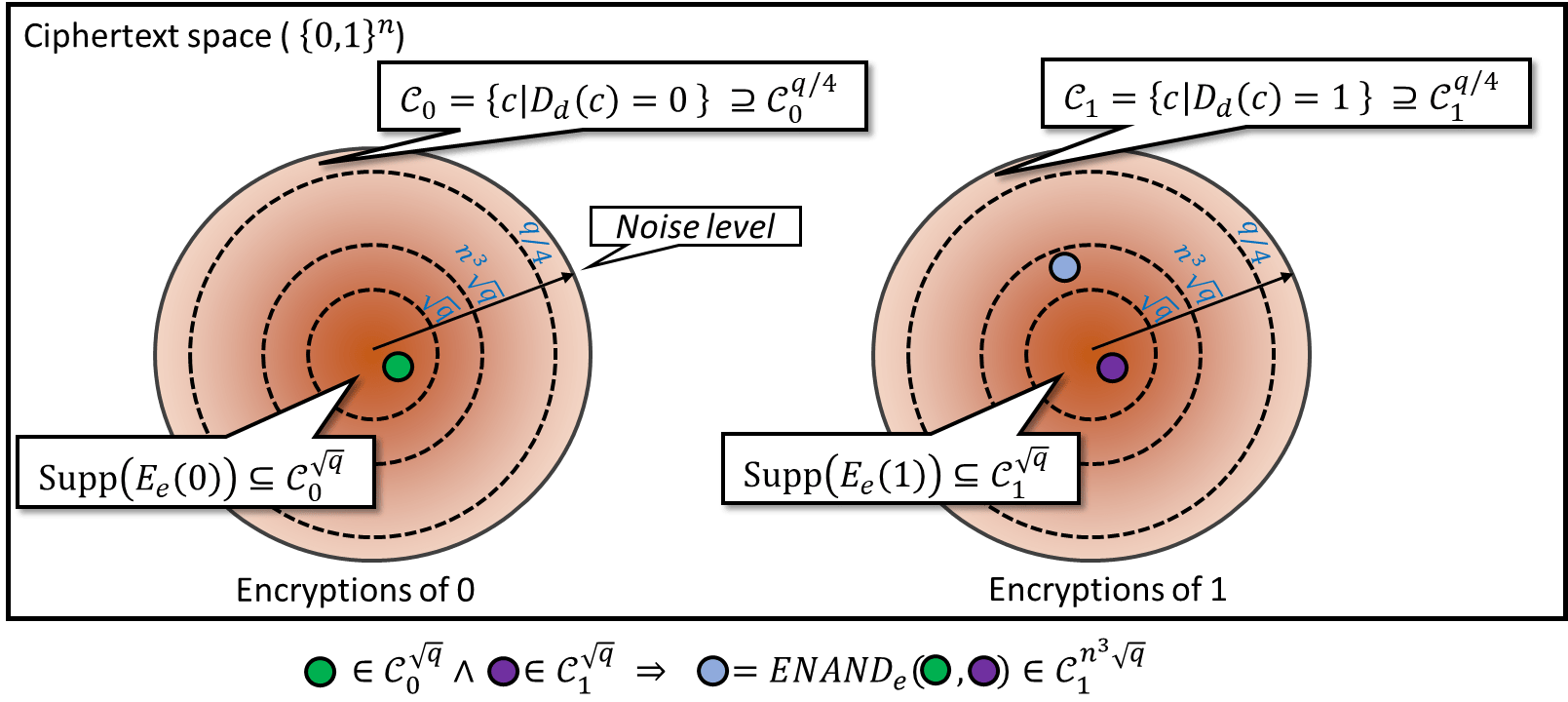
With the toolkit configured, you are ready to implement your first encrypted computation. The next step involves generating keys and encrypting a simple integer value.
Encrypt data before upload
The security of fully homomorphic encryption (FHE) relies entirely on the client-side workflow. Before any data leaves your environment, it must be transformed into ciphertext using the server’s public key. This ensures that the cloud provider never sees the raw plaintext, maintaining a zero-trust posture even if the underlying infrastructure is compromised.
Generate and distribute the public key
Every FHE implementation begins with a key pair generation step. You generate a private key locally to decrypt results later and a public key to encrypt inputs now. Distribute the public key to the server securely. The server uses this key to perform computations on the encrypted data. The private key never leaves your control, ensuring that only you can interpret the final output.
Encrypt plaintext with the public key
Once the key pair is established, you encrypt your data locally using the public key. This process converts readable values into complex ciphertext that appears as random noise. The server can perform arithmetic or logical operations on this ciphertext, but it cannot derive any information about the original values. This step is critical for protecting sensitive data during transit and while at rest on untrusted servers.
Send ciphertext for processing
After encryption, you upload only the ciphertext to the server. The server processes the data using FHE-compatible algorithms, producing encrypted results. Since the server operates on ciphertext, it never gains access to the underlying data. You then download the encrypted results and decrypt them locally using your private key to obtain the final answer.
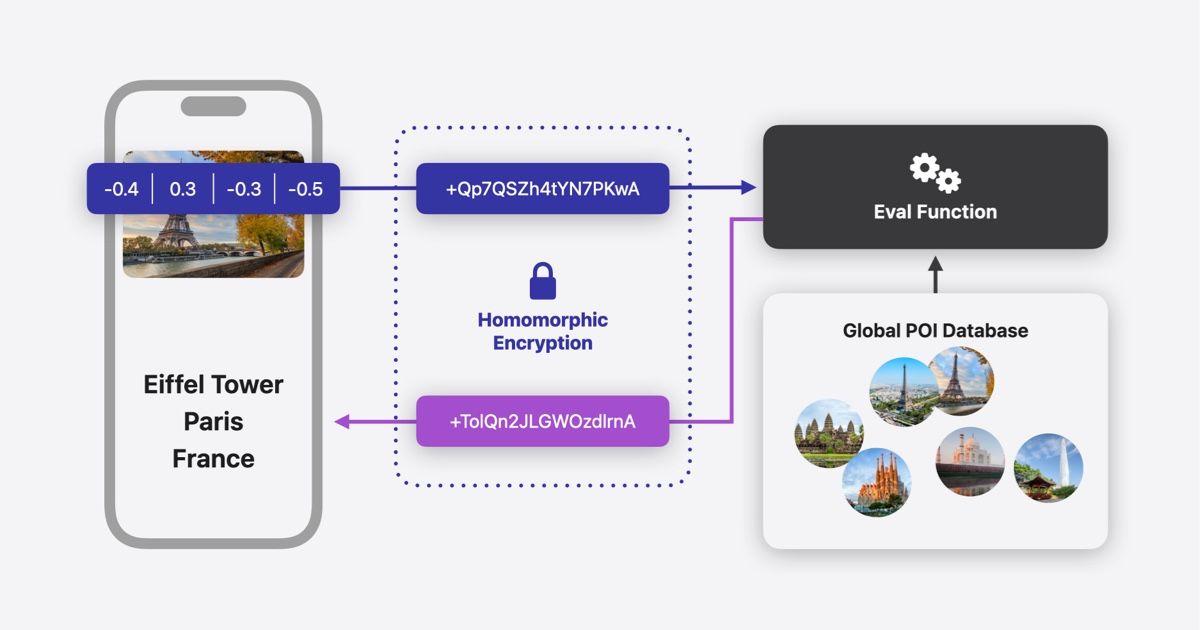
Generate a local key pair consisting of a private key for decryption and a public key for encryption. Keep the private key secure and never share it.
Use the public key to encrypt your plaintext data into ciphertext. This transformation ensures that the data remains unreadable to anyone without the private key.
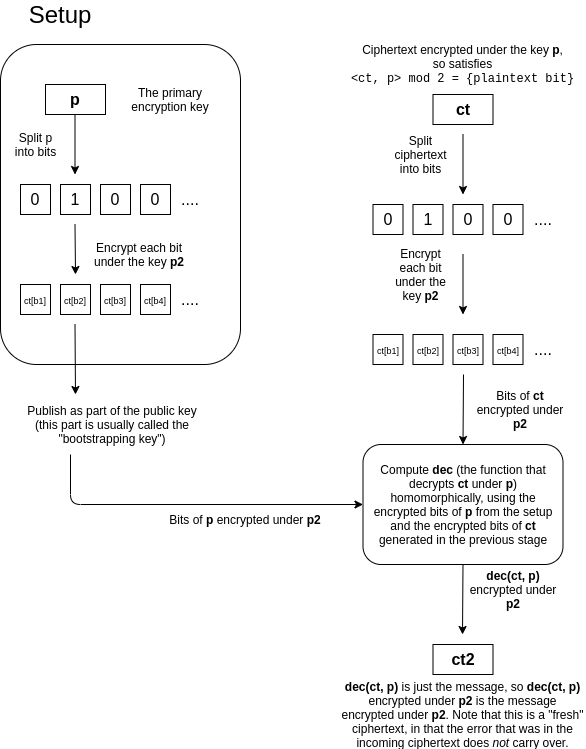
Send the encrypted data to the server. The server processes the ciphertext without ever decrypting it, maintaining data confidentiality throughout the computation.
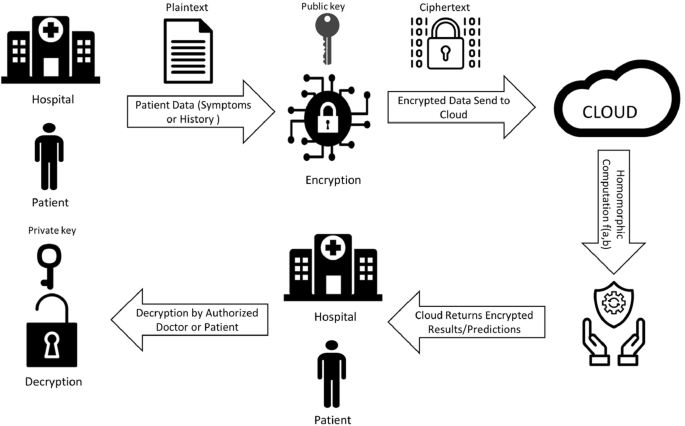
Download the encrypted results from the server and decrypt them using your private key. This reveals the final output while keeping the intermediate data secure.
Run computations on ciphertext
Once the data is encrypted, the computation phase is where fully homomorphic encryption (FHE) proves its utility. Unlike traditional encryption, which requires decryption before any processing can occur, FHE allows you to execute business logic or AI inference directly on the ciphertext. The server performs mathematical operations on the encrypted data as if it were plaintext, without ever seeing the underlying values.
This process relies on the homomorphic property of the encryption scheme. In a fully homomorphic system, you can perform both addition and multiplication on ciphertexts. These operations correspond to the same operations on the underlying plaintext messages. For example, if you encrypt two numbers $A$ and $B$, you can compute an encrypted sum $E(A + B)$ or product $E(A \times B)$ without knowing $A$ or $B$. The result, when decrypted by the authorized key, yields the correct answer.
The "blind" nature of this operation is critical for security. The computing environment treats the data as opaque noise. It applies the necessary gates and circuits to the ciphertexts, maintaining the encryption throughout the entire workflow. This ensures that even if the cloud provider or third-party processor is compromised, the sensitive information remains protected.
However, these computations are not free. FHE operations are significantly more computationally expensive than plaintext operations. Each multiplication introduces "noise" into the ciphertext. If the noise grows too large, the ciphertext becomes unrecoverable. To manage this, engineers often use bootstrapping techniques to refresh the ciphertext and reduce noise, or they design algorithms to minimize the depth of multiplication required.
In practice, this means your code must be adapted to work within the constraints of the FHE library. You cannot simply run standard Python or C++ functions. Instead, you use specialized libraries that map your business logic to homomorphic-friendly circuits. This includes using fixed-point arithmetic for floating-point operations and optimizing loops to reduce the number of sequential multiplications.
Decrypt results securely
Once the cloud provider finishes processing the encrypted data, the resulting ciphertext is returned to the authorized client. This is the final step in the fully homomorphic encryption workflow: recovering the plaintext answer from the encrypted computation output without ever exposing the raw data to the service provider.
The decryption process mirrors the initial encryption but uses the client’s private key. While the public key is used to lock the data and perform operations on it, only the private key can use the final result. This ensures that the cloud infrastructure remains blind to both the input data and the computed outcome.
In practice, this involves passing the encrypted result to a decryption function, such as decrypt(privateKey, encryptedResult). The algorithm applies mathematical transformations to reverse the encryption layers, yielding the original plaintext. For example, if the cloud computed the sum of two encrypted numbers, the client receives an encrypted sum and decrypts it to get the numeric total.
This step closes the loop on end-to-end security. The data remains protected throughout storage, processing, and transmission. Only the client, who holds the private key, can view the final answer. This guarantees that sensitive information stays confidential even when processed by untrusted third-party servers.
Check performance and costs
Before deploying fully homomorphic encryption (FHE) at scale, you must benchmark the computational overhead against your baseline unencrypted workloads. FHE introduces significant latency due to the complexity of homomorphic operations, particularly bootstrapping and ciphertext expansion. In 2026, hardware acceleration via GPU or specialized FHE chips has reduced this gap, but CPU-only deployments still face substantial performance penalties.
Cost implications extend beyond compute time to memory usage. Ciphertexts are often hundreds of times larger than plaintexts, driving up storage and bandwidth expenses. Use the comparison below to evaluate trade-offs between different FHE libraries and hardware configurations.
| Configuration | Relative Latency | Est. Cost Impact | Best For |
|---|---|---|---|
| CPU-only (SEAL) | 100x–1000x | High | Low-volume batch jobs |
| GPU-accelerated (HEAccel) | 10x–50x | Medium | Real-time inference |
| FPGA-accelerated | 5x–20x | Medium-High | Edge deployment |
| Cloud-native (Azure FHE) | Varies | Premium | Enterprise SaaS |
No comments yet. Be the first to share your thoughts!