
Get homomorphic encryption right
Before you integrate FHE into your stack, you need to align your data flow with the technology’s constraints. Homomorphic encryption allows computations on encrypted data, but it is not a drop-in replacement for standard encryption. It introduces significant computational overhead and latency that can stall real-time applications if not designed around.
Start by identifying which data types must remain encrypted during processing. FHE excels at specific mathematical operations like addition and multiplication, but it struggles with complex logic or large-scale data transformations. If your use case involves heavy conditional branching or non-linear functions, evaluate whether semi-homomorphic schemes or trusted execution environments might offer better performance.
Next, select a library that supports your target operations. Most FHE implementations are still experimental or require specialized hardware acceleration. Verify that the library you choose provides clear documentation on key generation, bootstrapping, and error tolerance. Without these basics, your private AI model will likely fail or produce unreliable results.
Work through the steps
Setting up a homomorphic encryption workflow requires moving from data preparation to secure computation and final decryption. Because fully homomorphic encryption (FHE) is computationally expensive, the order of operations matters to keep latency and costs manageable. Follow this sequence to build a functional private AI pipeline.
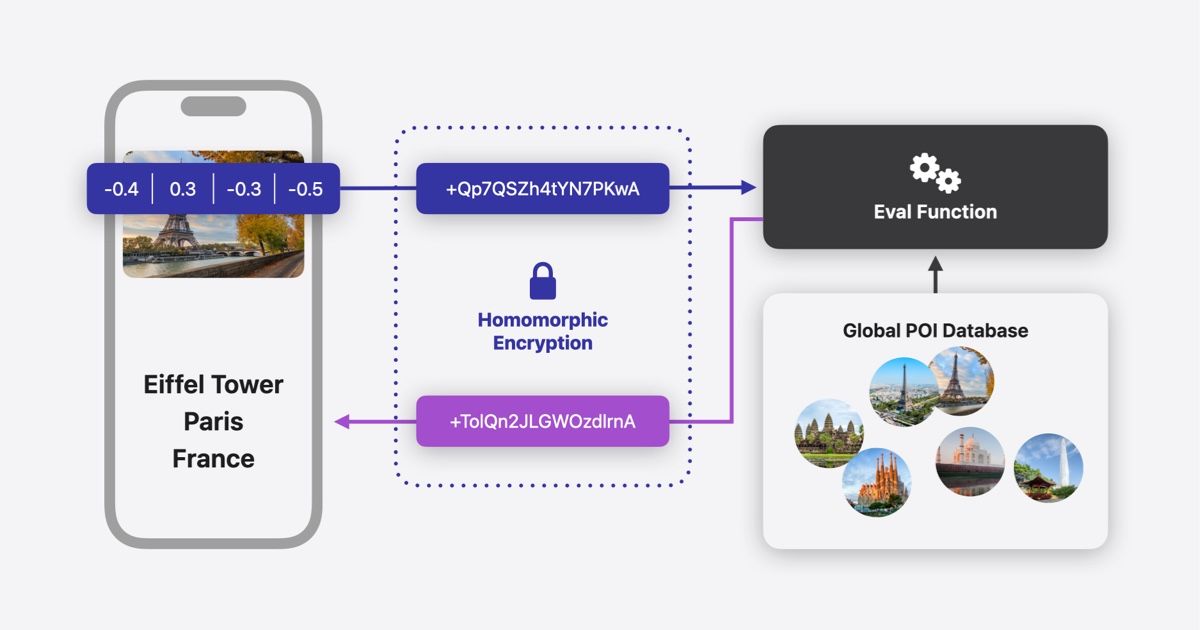
Before any computation occurs, your raw data must be encrypted using a public key. Unlike traditional encryption where data sits idle, FHE allows you to run algorithms directly on this ciphertext. Ensure your data is normalized and formatted correctly before encryption, as FHE schemes often struggle with non-numeric or unstructured data types. This step creates the secure input layer for your AI model.
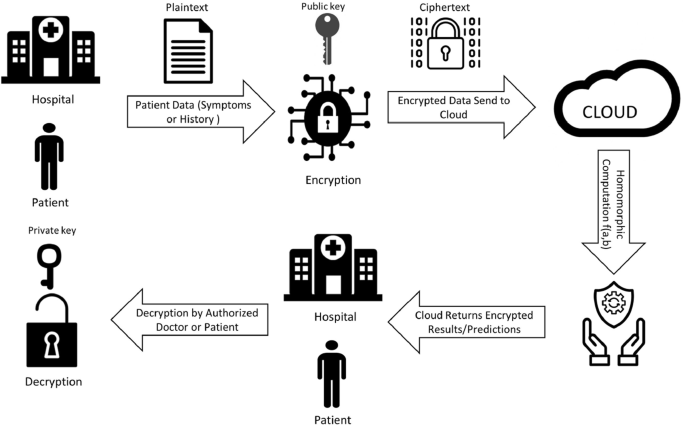
Not all homomorphic encryption is equal. Choose between partially homomorphic (supporting only addition or multiplication), somewhat homomorphic, or fully homomorphic schemes based on your AI task. For deep learning inference, you likely need a fully homomorphic scheme like BFV or BGV. Configure the parameters, such as polynomial modulus degree and coefficient modulus, to balance security levels with computational speed. Tighter parameters increase security but drastically slow down operations.

With your model weights and encrypted data in place, execute the inference or training steps. The computation happens entirely within the encrypted domain. Be aware that operations like matrix multiplications and non-linear activations (e.g., ReLU) are resource-intensive in FHE. You may need to approximate non-linear functions using polynomial expansions to keep the computation feasible. This is where the actual "private AI" magic happens.
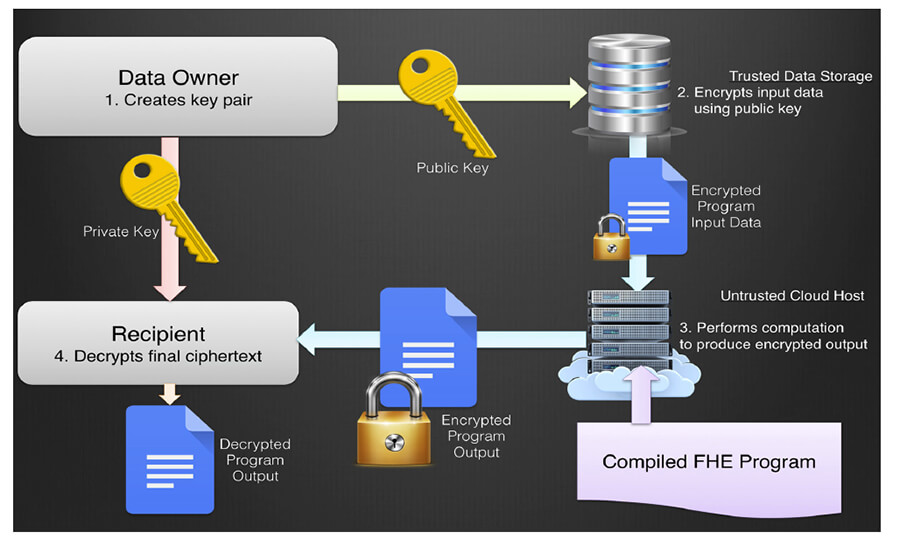
Once the computation is complete, use the private key to decrypt the resulting ciphertext. The output should match the result of performing the same operations on the plaintext data, minus minor rounding errors inherent in some FHE schemes. Verify the accuracy of the decrypted output against a known plaintext baseline to ensure the encryption and computation pipeline did not introduce significant noise or errors.
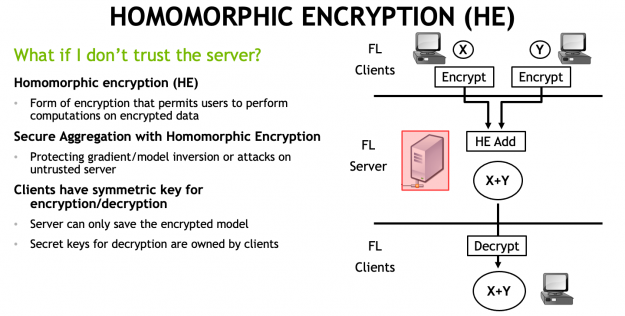
FHE is still computationally heavy. Optimize your workflow by batching multiple data points into a single ciphertext (SIMD operations) to amortize the overhead. Consider using hardware acceleration, such as GPUs or specialized FHE accelerators, if available. Regularly review your parameter settings; as hardware improves, you may be able to increase security levels without prohibitive performance penalties.
After completing the setup, use this checklist to ensure your private AI implementation is robust.
Common homomorphic encryption mistakes and how to fix them
Implementing homomorphic encryption (HE) often fails not because the math is wrong, but because the engineering choices ignore its unique constraints. Unlike standard encryption, where you decrypt before processing, HE allows calculations on ciphertexts. This power comes with a steep price: massive computational overhead and data expansion. To avoid poor outcomes, you must align your architecture with these realities rather than forcing traditional patterns onto an incompatible technology.
Treating encrypted data like plaintext
The most frequent error is assuming encrypted data behaves like standard bits. In HE, encrypted fields are significantly larger. A single integer might expand into a kilobyte of ciphertext. If you design your database schema or API payloads without accounting for this bloat, you will exhaust memory and bandwidth quickly.
Fix this by auditing your data structures early. Minimize the number of fields you need to encrypt. If you only need to search for specific values, consider using searchable encryption techniques rather than full homomorphic schemes. Keep the encrypted payload as small as possible to reduce the computational load.
Ignoring the noise budget
Every HE operation adds "noise" to the ciphertext. Once this noise exceeds a threshold, the data becomes unreadable. Developers often run too many operations in sequence, causing the computation to fail silently or return garbage results. This is known as exhausting the noise budget.
To fix this, map out your entire computation graph before writing code. Count every addition and multiplication. If your logic requires deep circuits, you must choose a scheme with a higher noise tolerance or break the process into smaller, intermediate decryption steps (bootstrapping), which is computationally expensive but necessary for complex logic.
Using HE for everything
Homomorphic encryption is not a silver bullet. It is currently thousands of times slower than plaintext processing. Using it for simple lookups or basic validation is like using a freight train to deliver a single letter. It works, but it is wildly inefficient and costly.
Reserve HE for high-value, high-sensitivity computations where privacy is non-negotiable, such as cross-institutional medical research or private financial modeling. For routine data processing, stick to standard encryption at rest and in transit. Only apply HE where the threat model demands computation on raw data without exposing it to the host environment.
Homomorphic encryption: what to check next
Before adopting homomorphic encryption (HE), it helps to separate the mathematical reality from the marketing hype. The technology is functional, but it is not a magic bullet for every privacy problem. Here are the answers to the most common practical objections.
No comments yet. Be the first to share your thoughts!