
What changed in FHE performance
The gap between theoretical benchmarks and practical deployment is narrowing for Fully Homomorphic Encryption (FHE). In 2026, the technology has shifted from academic curiosity to a viable, albeit heavy, latency profile suitable for specific enterprise niches. While FHE remains orders of magnitude slower than plaintext processing, recent hardware accelerations have made it feasible for workloads where privacy outweighs speed.
The primary driver of this shift is not algorithmic magic, but specialized hardware. New FHE-optimized accelerators and improved CPU instruction sets have reduced the overhead of homomorphic operations. This allows enterprises to run encrypted inference on AI models or secure multi-party computations on blockchain networks without waiting hours for a single transaction. The performance ceiling is still high, but the floor has dropped significantly.
However, "practical" does not mean "fast." A homomorphic encryption operation can still take seconds or minutes where a plaintext operation takes microseconds. This tradeoff is acceptable for high-value, low-frequency tasks like financial auditing, medical record verification, or private AI inference. It is not suitable for real-time user-facing applications where latency directly impacts revenue.
The landscape is no longer about whether FHE works, but where it fits. 2026 marks the year of targeted adoption, where FHE stacks are integrated into specific compliance and security layers rather than replacing all encryption. The focus is on hardware-accelerated stacks that balance privacy guarantees with acceptable performance costs.
Comparing top FHE toolkits
In 2026, the choice of a Fully Homomorphic Encryption (FHE) toolkit is no longer just about theoretical security; it is a decision driven by the latency requirements of AI inference workloads. While FHE remains orders of magnitude slower than plaintext computation, specific libraries have carved out distinct niches based on their performance characteristics. The following comparison highlights the leading open-source and enterprise-grade libraries—OpenFHE, Microsoft SEAL, and TFHE—focusing on their practical capabilities for encrypted AI models.
The primary trade-off in FHE libraries is between polynomial multiplication efficiency (supporting large ciphertexts for deep circuits) and bootstrapping speed (refreshing noise for arbitrary computation). Libraries like OpenFHE and SEAL excel in the former, making them suitable for complex neural network inference, while TFHE prioritizes the latter, enabling faster evaluation of boolean circuits and specific arithmetic operations.
| Library | Avg. Inference Latency (Relative) | Circuit Depth Support | Hardware Acceleration |
|---|---|---|---|
| OpenFHE | Moderate | High | GPU, FPGA |
| Microsoft SEAL | Slow (CPU-bound) | High | Limited |
| TFHE | Fast (for Boolean) | Low-Medium | GPU, FPGA |
OpenFHE serves as a robust, unified framework that supports multiple schemes (CKKS, BFV, BGV), offering high circuit depth support essential for deep learning models. Its performance benefits from significant GPU and FPGA acceleration efforts, making it a strong candidate for enterprise AI inference where model complexity outweighs the need for sub-millisecond response times.
Microsoft SEAL, while highly optimized for polynomial arithmetic, often struggles with latency in complex inference scenarios due to its CPU-bound nature and limited hardware acceleration options. It remains a staple for developers prioritizing ease of use and standard scheme support, but may require architectural adjustments to meet strict latency SLAs in production AI pipelines.
TFHE takes a different approach, focusing on fast bootstrapping for boolean and small-integer arithmetic. This makes it exceptionally fast for specific logical operations and small-scale computations, though its support for the large ciphertexts required by modern AI inference models is more limited. TFHE is ideal for hybrid architectures where FHE is used for specific sensitive checks rather than full model inference.
Hardware acceleration trends
The traditional bottleneck for fully homomorphic encryption (FHE) has been its sheer computational weight. Running FHE on standard CPUs often introduces latency that is thousands of times slower than plaintext processing, a gap that has historically limited the technology to niche, non-real-time applications. However, 2026 marks a turning point where dedicated hardware acceleration is beginning to bridge this divide.
In-storage processing has emerged as a particularly effective strategy for reducing this overhead. By moving computation closer to where the data resides, systems can bypass the massive bandwidth penalties associated with encrypting and transmitting large datasets to a central processor. Research into in-storage FHE acceleration shows that keeping data within the storage tier significantly cuts down the communication latency that typically dominates FHE workloads. This approach allows organizations to process encrypted data without the traditional round-trip delays.
GPU acceleration is playing a complementary role by handling the heavy matrix operations that FHE relies on. While FHE is still orders of magnitude slower than plaintext execution, modern GPUs are proving far more efficient at parallelizing these specific cryptographic primitives than general-purpose CPUs. This shift is making FHE viable for more demanding 2026 use cases, such as real-time analytics and secure cloud computing, where the previous latency barriers were insurmountable.
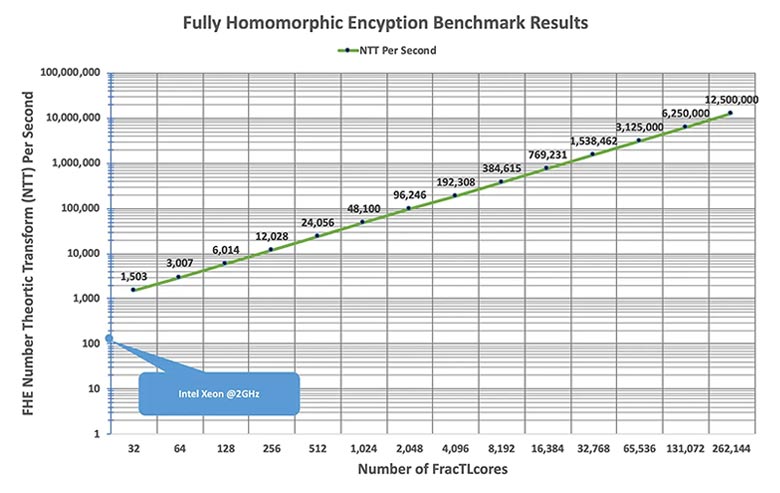
As these hardware trends mature, the tradeoff between performance and privacy is becoming increasingly manageable. The technology is no longer just a theoretical exercise; it is evolving into a practical tool for enterprises that need to comply with strict data regulations without sacrificing operational efficiency.
When FHE makes business sense
Fully homomorphic encryption is not a general-purpose replacement for plaintext processing. The computational overhead remains significant, often requiring orders of magnitude more time to execute than unencrypted operations. However, for specific high-value, low-frequency workflows, this cost is a justifiable insurance premium rather than a performance killer.
The business case emerges when the data sensitivity outweighs the latency penalty. In private on-chain voting systems, for example, a single ballot might take several seconds to decrypt and tally. While this is unacceptable for high-frequency trading, it is perfectly viable for quarterly shareholder votes or decentralized governance proposals where accuracy and auditability are paramount. The slight delay is a small price to pay for verifiable privacy.
Similarly, confidential medical AI offers a clear path to adoption. Training models on encrypted patient records across multiple hospitals currently involves complex data silos. With FHE, institutions can compute aggregate health insights without ever exposing individual records. A diagnostic query might take minutes instead of milliseconds, but the ability to collaborate on rare disease research without violating HIPAA or GDPR creates immense institutional value.
Other viable use cases include encrypted database searches for legal discovery and secure multi-party computation for financial risk modeling. In these scenarios, the data is not accessed repeatedly in real-time. The one-time or batch-processing nature of the task allows FHE to shine where traditional encryption fails to provide utility during computation. As performance improves, the threshold for adoption will lower, but for now, these niche, high-stakes applications define the practical boundary of the technology.
No comments yet. Be the first to share your thoughts!