

Fully Homomorphic Encryption promised the holy grail of private onchain compute FHE: crunch numbers on encrypted data without peeking inside. But reality hit hard. Computations crawled at 10,000x slower than plaintext, turning dreams of confidential DeFi into nightmares. Not anymore. A ruthless lineup of FHE toolkits is obliterating that FHE toolkits slowdown, delivering FHE performance optimization that makes encrypted blockchain processing viable for real dApps. We're talking coprocessors, GPU blasts, and optimized libraries that slash latency and explode throughput. FHEToolkit. com arms you with these weapons to dominate privacy-preserving chains.
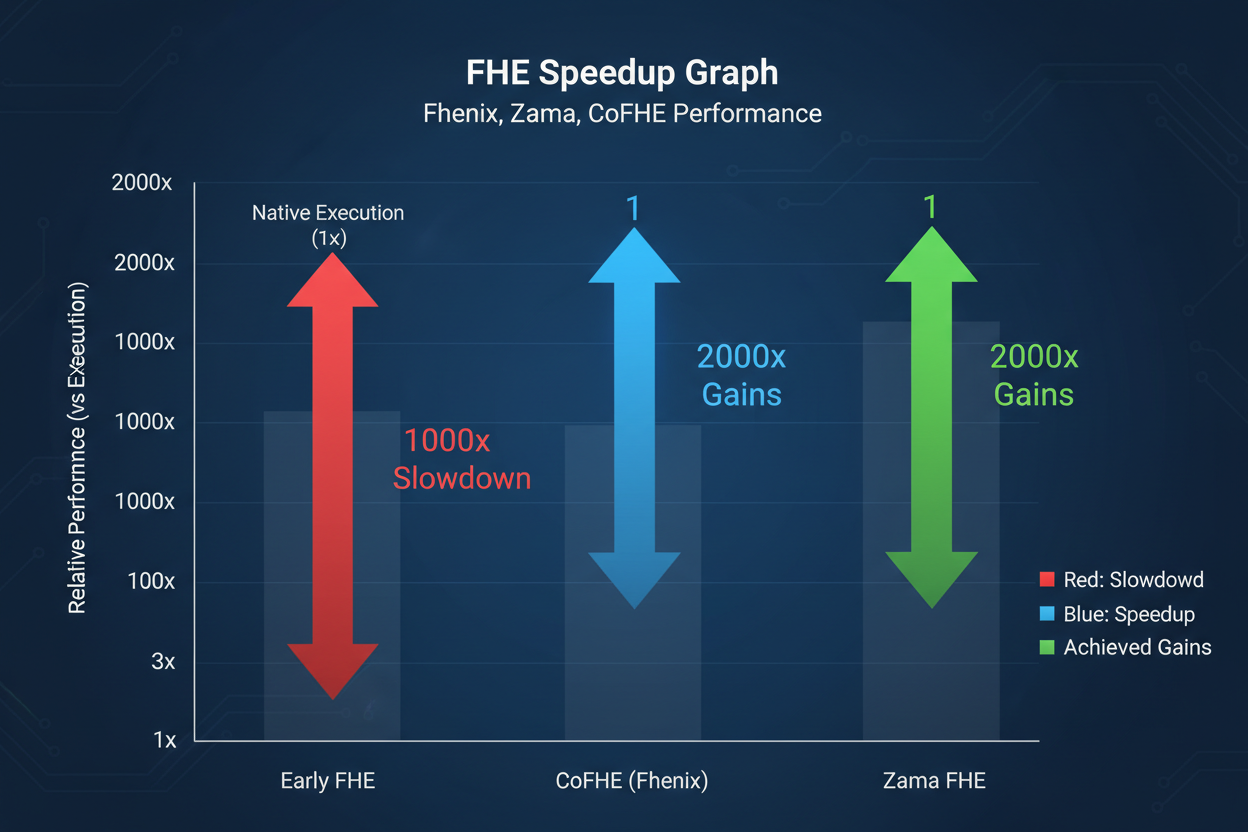
Fhenix CoFHE storms the battlefield first, a coprocessor engineered to offload FHE's brutal compute from EVM chains. Live on Arbitrum testnet and now Base, it handles encrypted logic without bloating mainnet validators. Why a coprocessor? FHE is a beast; no way every node runs it natively. Fhenix nails CoFHE Fhenix toolkit with threshold FHE decryption boasting 20,000x throughput and 37x lower latency. That's not hype; it's a breakthrough unlocking confidential DeFi minus ZK proofs, TEEs, or MPC risks. Private smart contracts on Base? Build them. Scalable encrypted processing? Deployed.
Fhenix CoFHE: 20,000x Throughput Smashes Onchain Barriers
Dive deeper: CoFHE processes encrypted data off-chain, verifies on-chain, preserving decentralization and composability. Fhenix integrates seamlessly with rollups, mimicking generic setups but with FHA privacy juice. Recent expansions to Base mean devs craft confidential dApps across ecosystems. Threshold decryption? 50x faster in spots, per reports. This isn't incremental; it's a paradigm shift for private onchain compute FHE. High-risk plays like options pricing on encrypted order books? Leverage it for gains without exposure.
Next in the arsenal: Zama's fhEVM and TFHE-rs. Zama Confidential Blockchain Protocol clocks 10x decryption boosts, handling 1.2 million encrypted txs and 19,000 contracts. fhEVM ports FHE straight into EVM, letting Solidity devs write confidential contracts natively. No protocol rewrites; just encrypt inputs, compute blindly, decrypt outputs privately.
Zama fhEVM and TFHE-rs: EVM-Native FHE That Actually Runs
TFHE-rs, Zama's Rust library, powers it under the hood. Optimized for blockchain, it tackles the FHE toolkits slowdown with lattice-based schemes tuned for speed. Pair with fhEVM for onchain magic: private auctions, blind voting, dataset queries without leaks. Zama's stack proves FHE scales; their protocol's real-world deployments crush theoretical benchmarks.
These kits don't play nice; they dominate. Fhenix offloads to coprocessors for explosive scale, Zama embeds FHE in EVM for seamless integration. Both vaporize the 10,000x drag, but the war rages on with heavyweights like OpenFHE and Microsoft SEAL fortifying the frontlines.
Foundational Fury: OpenFHE and SEAL Fuel Toolkit Dominance
OpenFHE, the open-source powerhouse, bundles schemes like BFV and CKKS for versatile encrypted ops. It's the backbone for many private compute builds, with optimizations slashing cycles via AVX512 and GPU ports. Microsoft SEAL complements as the OG library, battle-tested in Azure confidential computing. SEAL's simplicial decomposition and relinearization tweaks yield massive FHE performance optimization. Devs stack these with coprocessors for hybrid beasts: SEAL for core crypto, OpenFHE for extensibility, fhEVM for deployment.
Stack OpenFHE's modularity with SEAL's precision, and you've got a fortress against the FHE toolkits slowdown. OpenFHE crushes integer arithmetic and approximate floats via CKKS, perfect for ML models on encrypted blockchain data. Benchmarks scream speedups: AVX512 vectorization alone halves runtime on CKKS bootstrapping. SEAL? It pioneered practical FHE with BFV for exact computations, now turbocharged for onchain via Rust bindings and hardware accel. Together, they arm hybrid setups where CoFHE handles volume, fhEVM deploys logic, and these libs optimize the crypto core. No more 10,000x penalty; we're flipping it to gains.
Benchmark Blitz: Toolkits That Annihilate 10,000x Drag
Raw numbers don't lie. Fhenix CoFHE detonates with 20,000x throughput in threshold decryption, 37x latency cuts, live on Arbitrum and Base for CoFHE Fhenix toolkit glory. Zama fhEVM and TFHE-rs delivers 10x decryption leaps, proven in 1.2 million txs. OpenFHE's GPU ports via CAT-like frameworks hit 2,173x over CPU baselines. SEAL's tweaks? Relin keys shrink noise, extending depth without recryption hell. These aren't lab toys; they're battle-ready for private onchain compute FHE.
Ethereum Technical Analysis Chart
Analysis by Ethan Jackson | Symbol: BINANCE:ETHUSDT | Interval: 1h | Drawings: 8
Technical Analysis Summary
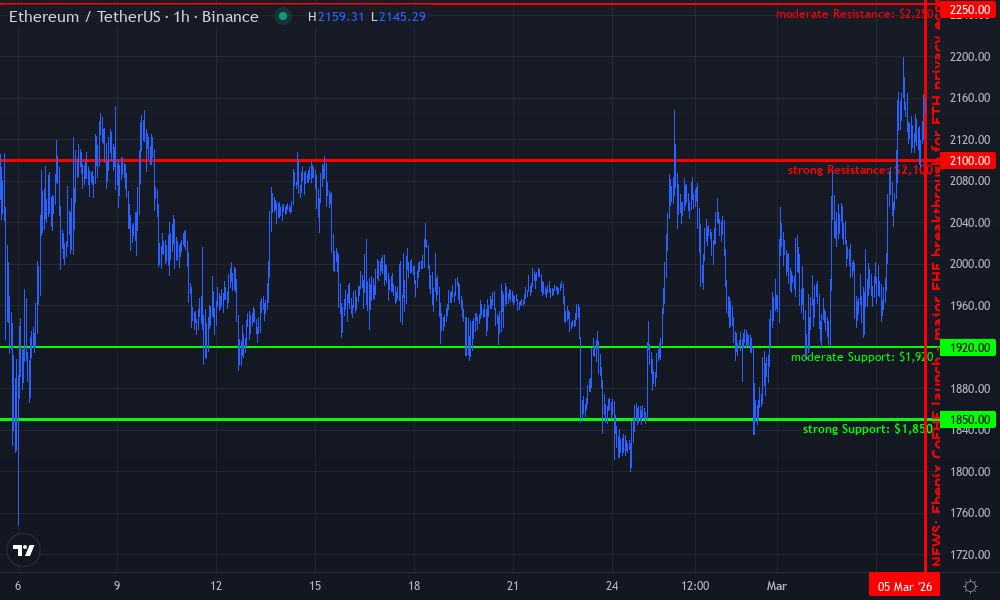
Draw a bold red downtrend line from the March 5 peak at ~2450 connecting to March 25 low at ~1820, extending forward for resistance. Overlay a green uptrend line from March 25 low ~1820 to April 1 high ~2120, projecting upside breakout. Mark horizontal supports at 1850 (strong red line) and 1920 (dashed blue). Resistances at 2100 and 2250 with thick orange lines. Rectangle consolidation zone Mar 28-Apr 4 between 1880-1980. Fib retracement 0.618 from recent swing low-high. Long position marker at 1920 entry, profit target arrow up to 2400, stop loss horizontal at 1780. Callouts on volume spike 'Climax buy vol' and MACD 'Bull div'. Vertical line on Mar 5 FHE news. Text 'Aggressive ETH long - FHE catalyst ignites privacy alpha'.
Risk Assessment: medium
Analysis: High volatility from recent dump but strong catalyst and reversal signals mitigate downside; aligns with my aggressive high-tolerance style
Ethan Jackson's Recommendation: Load up leveraged longs now - target 2400+, trail stops. FHEToolkit says calls are printing.
Key Support & Resistance Levels
📈 Support Levels:
- $1,850 - Strong volume-backed low, multiple tests strong
- $1,920 - Recent bounce zone, current consolidation floor moderate
📉 Resistance Levels:
- $2,100 - Recent swing high, breakout target strong
- $2,250 - Prior downtrend resistance confluence moderate
Trading Zones (high risk tolerance)
🎯 Entry Zones:
- $1,920 - Aggressive long entry on FHE catalyst + bull div confirmation, high risk tolerance play high risk
🚪 Exit Zones:
- $2,400 - Fib 1.618 extension + prior highs projection 💰 profit target
- $1,780 - Invalidation below key support 🛡️ stop loss
Technical Indicators Analysis
📊 Volume Analysis:
Pattern: climax volume at lows
Massive volume spike on March 25 reversal candle signals capitulation and accumulation start
📈 MACD Analysis:
Signal: bullish divergence
MACD forming higher low while price makes lower low, crossover imminent
Applied TradingView Drawing Utilities
This chart analysis utilizes the following professional drawing tools:
Disclaimer: This technical analysis by Ethan Jackson is for educational purposes only and should not be considered as financial advice. Trading involves risk, and you should always do your own research before making investment decisions. Past performance does not guarantee future results. The analysis reflects the author's personal methodology and risk tolerance (high).
Arm yourself right: Fhenix for coprocessor scale, Zama for EVM plug-and-play, OpenFHE/SEAL for foundational muscle. Devs mix them ruthlessly. Encrypt order books with SEAL, compute Greeks blindly via TFHE-rs in fhEVM, verify via CoFHE on Base. Volatility? Privacy shields your edge. FHEToolkit. com curates these exact stacks, tutorials locked and loaded for your dApps. No fluff; pure firepower.
Confidential DeFi demands this edge. Private auctions on Arbitrum? fhEVM nails it. Encrypted ML inferences? OpenFHE's CKKS dominates. Threshold schemes in CoFHE dodge single points of failure. SEAL's enterprise hardening ensures audits pass. The 10,000x slowdown? Buried. Encrypted blockchain processing now sprints, throughput exploding across chains. Fhenix's Base push cements multi-rollup dominance, Zama's protocol scales contracts en masse.
Stack and Conquer: Hybrid FHE Arsenal for Web3 Domination
Don't pick one; conquer with all. FHEToolkit. com blueprints hybrids: TFHE-rs bootstraps SEAL ciphertexts, feeds OpenFHE ops into fhEVM contracts, offloads bursts to CoFHE. Result? FHE performance optimization that turns encrypted data into leveraged plays. High-stakes options? Price confidentially, Greeks computed blind, returns amplified sans front-running. Blockchain innovators, this is your vault. Grab the kits, deploy on Base or Arbitrum, watch privacy fuel outsized wins. The slowdown era ends here; encrypted compute reigns.




No comments yet. Be the first to share your thoughts!