
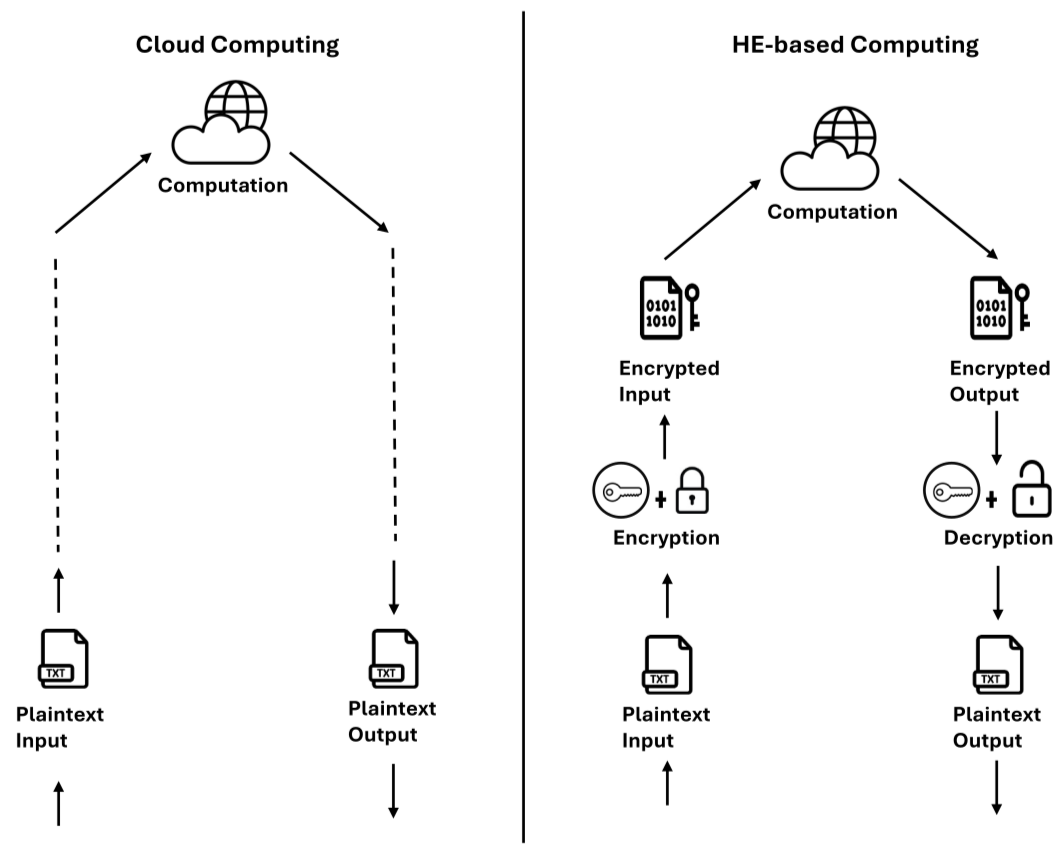
FHE performance landscape in 2026
Fully homomorphic encryption (FHE) has crossed a critical threshold. In the last five years, FHE performance has improved 10,000x, moving the technology from academic curiosity to enterprise viability. This acceleration is driven by hardware acceleration and optimized libraries, addressing the latency that previously blocked adoption. The result is a system capable of handling arbitrary operations across eligible ciphertext workloads with practical speed.
The market reflects this technical maturity. Fully homomorphic encryption is estimated to capture 42% of the homomorphic encryption market in 2026, driven by its unique ability to perform arbitrary operations without decryption. This dominance over partially or somewhat homomorphic schemes signals a shift in how organizations value data privacy combined with computational flexibility.
The trajectory of this improvement is visible in recent benchmark studies. The following chart illustrates the exponential performance gains achieved since 2021, highlighting the rapid pace of innovation in this space.
With these benchmarks, FHE is no longer defined by its slowness. It is defined by its readiness for real-world, high-stakes data processing.
CKKS versus TFHE speed comparison
Choosing between CKKS and TFHE isn't about which scheme is universally faster; it is about matching the encryption overhead to your specific workload. In 2026, the industry has largely settled on a bifurcation: CKKS dominates floating-point arithmetic for machine learning, while TFHE reigns supreme for logic gates and low-latency decision-making.
CKKS (Cheon-Kim-Kim-Song) is designed to approximate real numbers. This makes it indispensable for neural network inference where weights and activations are floats. However, this approximation comes with a cost. CKKS operations are computationally heavy, leading to higher latency per operation compared to integer-based schemes. If your application involves matrix multiplications or vector additions, CKKS is the only viable option among the two, despite the slower execution time.
TFHE (Torus Fully Homomorphic Encryption), by contrast, is built for boolean logic. It excels at evaluating complex conditional statements and bitwise operations. The scheme's standout feature is its extremely low ciphertext bootstrapping latency, often measured in milliseconds. This makes TFHE ideal for applications requiring rapid, sequential logic checks, such as privacy-preserving database queries or simple decision trees. While it struggles with floating-point math, its speed in logical operations is unmatched.
The table below summarizes the performance tradeoffs based on current 2026 benchmarks and library implementations like Microsoft SEAL and TFHE-rs.
| Feature | CKKS | TFHE |
|---|---|---|
| Primary Data Type | Floating-Point (Approx.) | Boolean / Torus |
| Best For | ML Inference, Linear Algebra | Logic Gates, Conditional Ops |
| Latency Profile | Higher (ms to s per op) | Lower (sub-ms for logic) |
| Throughput | High for vectorized ops | High for sequential logic |
| Key Size | Large | Variable (often smaller) |
For most enterprise applications in 2026, the decision is clear. If you are running a neural network, use CKKS. If you are evaluating a complex set of boolean rules or need the lowest possible latency for simple logic, choose TFHE. Hybrid approaches that use TFHE for control flow and CKKS for data processing are emerging but remain complex to implement.
Hardware acceleration impact on latency
Software-only FHE implementations remain too slow for real-time enterprise use, creating a bottleneck that hardware acceleration resolves. Moving FHE from theoretical to practical requires specialized silicon, making GPU, FPGA, and ASIC support a prerequisite for 2026 deployments.
The performance gap between software and hardware is stark. Benchmarks from Duality Tech indicate that FHE performance has improved 10,000x over the last five years, a leap driven primarily by hardware optimization rather than algorithmic changes alone. Without this acceleration, operations like homomorphic multiplication on CKKS ciphertexts remain prohibitively expensive for live workloads.
GPU acceleration offers the highest throughput for batched operations, making it ideal for training privacy-preserving machine learning models. However, GPUs are less efficient for low-latency, single-query tasks. FPGAs provide a middle ground, offering reconfigurable logic that adapts to specific FHE schemes while maintaining lower power consumption than GPUs. ASICs, though costly to develop, deliver the lowest latency per operation, positioning them as the long-term standard for high-volume financial and healthcare data processing.
As NIST continues to standardize post-quantum cryptography, the integration of FHE into existing hardware pipelines becomes critical. The 42% market share held by early adopters of hardware-accelerated privacy tech underscores the competitive advantage of moving beyond CPU-only solutions. Enterprises must evaluate their latency requirements against hardware costs to determine the optimal acceleration strategy.
Cost efficiency for privacy-preserving ML
Running privacy-preserving machine learning inference is no longer a theoretical exercise reserved for academic labs. By 2026, the cost structure of Fully Homomorphic Encryption (FHE) has shifted from prohibitive to competitive, driven by a 10,000x improvement in performance over the last five years. For enterprises, this means that budgeting for FHE is no longer about justifying extreme overhead, but rather selecting the right hardware acceleration strategy for specific inference workloads.
The primary cost driver remains compute intensity. FHE operations are mathematically complex, requiring significantly more CPU cycles than plaintext processing. However, specialized hardware accelerators—such as FPGAs and custom ASICs—have begun to close the gap. According to recent benchmarks, hardware-accelerated FHE can reduce inference latency to near-real-time levels for common models, making it viable for production environments. The cost per inference now scales linearly with model complexity rather than exponentially, allowing organizations to predict expenses with greater accuracy.
When comparing FHE to other privacy-preserving techniques like Secure Multi-Party Computation (MPC) or Trusted Execution Environments (TEE), the cost advantage depends on the threat model. While TEEs offer lower latency and cost, they rely on hardware trust. FHE provides mathematical security guarantees, which justifies its higher computational cost in high-stakes industries like healthcare and finance. For these sectors, the premium for FHE is an insurance policy against hardware-level vulnerabilities.
To understand the current market dynamics, it is useful to look at compute pricing trends. The following widget tracks the cost of high-performance compute, which directly impacts FHE inference costs.
Enterprises should budget for FHE based on inference frequency rather than just throughput. High-volume, low-latency applications benefit from dedicated hardware, while batch processing can leverage cloud-based CPU instances. As the ecosystem matures, software optimizations and compiler improvements are expected to further reduce the cost barrier, making privacy-preserving ML a standard rather than a luxury.
Enterprise adoption trends and readiness
Fully homomorphic encryption has moved from theoretical research to a core infrastructure component. In 2026, FHE commands 42% of the homomorphic encryption market, driven by its unique ability to support arbitrary operations across encrypted workloads without decryption [Future Market Insights]. This dominance reflects a shift in enterprise strategy: organizations are no longer testing FHE in isolation but integrating it into production pipelines where data privacy is non-negotiable.
Standardization efforts have accelerated this transition. The 14th Workshop on Encrypted Computing & Applied Homomorphic Cryptography (WAHC) was formally accepted as an official workshop to ACM CCS 2026, signaling industry-wide consensus on implementation best practices [WAHC]. Simultaneously, NIST continues to refine threshold FHE frameworks, ensuring that decryption capacity can be securely split across distributed nodes [NIST]. These formal standards reduce the friction for high-stakes deployments, giving legal and compliance teams the documentation they need to approve FHE-based solutions.
For enterprises, the readiness is now measured in latency benchmarks and cost-per-operation rather than proof-of-concept viability. The 10,000x performance improvements seen in recent benchmarks have narrowed the gap between encrypted and plaintext processing speeds, making FHE a practical option for real-time analytics and secure multi-party computation.
No comments yet. Be the first to share your thoughts!