
The 2026 shift to encrypted computation
Fully Homomorphic Encryption (FHE) is moving from theoretical research to practical enterprise deployment in 2026. This transition is driven by regulatory pressure and the urgent need for privacy in AI systems. Companies can now process sensitive data without exposing it, enabling secure computation across AI, blockchain, and healthcare sectors.
The 2026 FHE.org conference in Seoul highlighted this shift, with industry leaders discussing standardization and implementation strategies. IBM research further supports this trend, demonstrating how FHE can be integrated into existing enterprise infrastructure. These developments mark a tipping point where encrypted computation becomes a viable option for large-scale data processing.
Privacy-preserving AI model inference
Enterprises are deploying FHE to protect proprietary models and sensitive user data during inference. The primary constraint is latency; homomorphic operations are computationally expensive compared to plaintext processing. To make this viable, organizations must separate must-have requirements—such as strict data sovereignty and regulatory compliance—from nice-to-have features like ultra-low latency for real-time consumer applications.
A practical implementation strategy involves using FHE for high-value, low-frequency queries rather than high-throughput batch processing. For example, a financial institution can use FHE to verify creditworthiness using encrypted bank statements without exposing the underlying transaction history to the AI model provider. This approach ensures that the model learns from aggregated patterns without accessing individual plaintext records.
On-chain confidentiality for blockchain
Public blockchains face a fundamental transparency paradox: every transaction is visible, yet enterprises require strict data privacy. Fully Homomorphic Encryption (FHE) resolves this by allowing smart contracts to execute computations on encrypted data. The blockchain verifies the logic without ever decrypting the underlying information, effectively turning public ledgers into private processing engines.
This capability enables confidential transactions where the amount, sender, and recipient remain hidden from the network while still satisfying consensus rules. For example, a supply chain consortium can verify inventory levels against smart contract conditions without exposing sensitive vendor pricing or stock counts to competitors or the public. The data stays locked in ciphertext, but the business logic proceeds as if it were plain text.
Enterprise implementation relies on recent breakthroughs in computational efficiency. Research presented at the 2026 FHE.org conference highlights new schemes that reduce the overhead of homomorphic operations, making real-time contract execution viable for high-frequency trading and private healthcare records. IBM research further demonstrates how integrating FHE with existing blockchain infrastructure allows organizations to deploy privacy-preserving applications without abandoning established consensus mechanisms.
The result is a hybrid model where auditability meets confidentiality. Regulators can verify compliance proofs generated by the smart contract, while the actual sensitive data remains protected. This approach shifts blockchain from a transparent ledger to a secure, private data processing layer, enabling enterprise use cases that were previously impossible due to regulatory constraints.

Hardware acceleration and in-storage processing
Full homomorphic encryption (FHE) has long faced a performance penalty that makes enterprise deployment difficult. Processing encrypted data requires complex mathematical operations that standard CPUs handle slowly. To make FHE viable for large-scale applications, engineers are moving computation closer to the data itself. This approach reduces latency and leverages specialized hardware to accelerate the heavy lifting.
In-storage processing allows data to remain encrypted on the disk while computations happen directly on the storage device. This eliminates the need to decrypt data before processing, which significantly reduces exposure to security risks. By handling encryption at the storage layer, enterprises can process sensitive information without ever exposing the plaintext to the main memory or CPU.
Recent research highlights the potential of this architecture. At the 2026 FHE.org conference, IBM presented FHEIns, a system designed to accelerate FHE for large data applications using in-storage processing. Their work demonstrates that specialized hardware can handle the computational load of encryption more efficiently than traditional server-side methods.
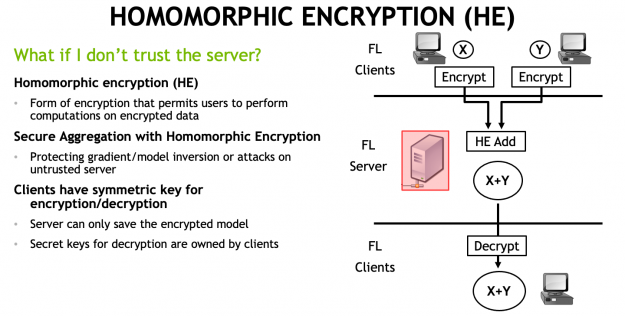
Implementing these strategies requires a shift in infrastructure planning. Organizations must evaluate their storage systems for compatibility with encryption acceleration. The goal is to deploy systems where security and performance are not mutually exclusive. As hardware capabilities improve, in-storage processing will likely become the standard for secure data handling.
Key questions on FHE research and adoption
Homomorphic encryption is no longer a theoretical concept confined to academic papers. Active development continues at a rapid pace, with organizations like FHE.org hosting dedicated conferences to discuss implementation strategies and standardization efforts for the coming year.
Is homomorphic encryption still being researched?
Yes, research is expanding into practical, large-scale applications. Recent developments highlight specific use cases such as the secure sharing of genomic data, allowing healthcare providers to analyze sensitive patient information without exposing the underlying records. This shift from theory to deployment is central to current industry discussions.
Can FHE be implemented in large-scale industries today?
Implementation is becoming viable for enterprises ready to integrate FHE into their data pipelines. While performance optimization remains an ongoing focus, several strategies allow organizations to deploy FHE for specific high-value workloads, such as financial fraud detection and private AI inference, without compromising operational speed.
What are the main barriers to adoption?
The primary hurdle is computational overhead. Running calculations on encrypted data requires more processing power than standard methods. However, hardware acceleration and improved software libraries are steadily reducing this gap, making FHE a realistic option for enterprises handling regulated data in 2026.
No comments yet. Be the first to share your thoughts!